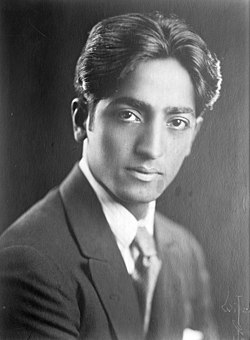
Krishnamurti asserted that "truth is a pathless land" and advised against following any doctrine, discipline, teacher, guru, or authority, including himself.[5] Nonetheless, during his life he tried to share his insights in 'the teachings', urging for a state without conceptual deliberations and thought.[f] In Krishnamurti's perception, such a righteousness was only possible through the practice of passive or choiceless awareness, which he called the essence of "true meditation" in contrast to contrived techniques.[6][g] He gained a wider recognition in the 1950s, after Aldous Huxley had introduced him to his mainstream publisher and the publication of The First and Last Freedom (1954). Many of his talks have been published since, among them Commentaries on Living (1956–60) and Krishnamurti's Notebook (written 1961-62).